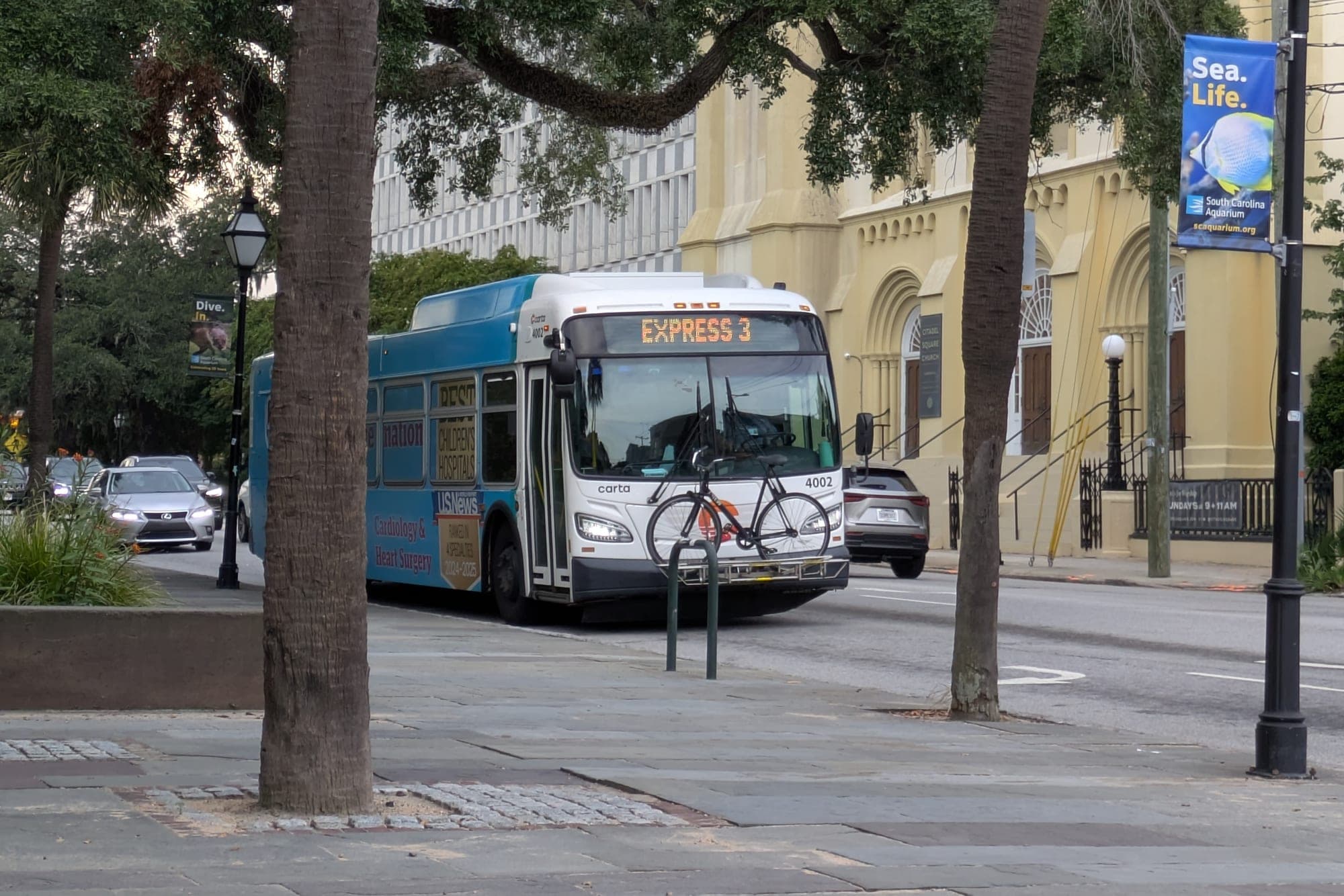
The Charleston area’s public bus system has started its new fiscal year with less federal money, fewer riders than a year ago and a proposal to rent buses from Florida.
The board of the Charleston Area Regional Transportation Authority, known as CARTA, unanimously approved a $38.8 million operating budget on Sept. 23 for the year that began Oct. 1, according to minutes in the agenda packet for its Oct. 21 meeting. The local governments that are CARTA’s members had already approved it, the minutes say.
The budget projects $9.5 million in federal revenue, down about $5 million from the revised budget for the year that ended Sept. 30. Revenue from the Charleston County transportation sales tax rises about $2.5 million, to $16.8 million, making it CARTA’s largest source of operating money. The plan also draws $7.5 million from the agency’s fund balance.
“The decrease in Federal funding is a projection of federal grant awards,” Robin Mitchum, CARTA’s deputy director of finance and administration, wrote in a budget memo.
Where the money goes
The biggest increase is for the contractor that drives CARTA’s buses. The fixed-route service line rises about $4 million, to $22.9 million. RATP Dev USA took over that work from National Express, and the budget for the year that just ended carried $1.3 million in onboarding costs for the switch, according to CARTA’s financial reports.
Paratransit, the door-to-door service for riders with disabilities, will cost $5.7 million, up $1.2 million, for what the memo calls “anticipated operator costs.” Insurance rises to $1.5 million from $1.1 million. The memo says the Insurance Reserve Fund expects comprehensive and collision coverage to rise 15% and auto liability coverage to rise 40% at renewal.
Vehicle maintenance goes the other way. The revised budget for the year that just ended set aside $5.2 million for it, including $4.4 million for repairs to CARTA’s Proterra electric buses. The new budget calls for $363,000 and nothing for Proterra repairs.
The new operating budget is slightly smaller than last year’s revised $40.1 million. Both are well above the $29.1 million budget CARTA started last year with.
A separate $23.5 million capital budget includes $9.2 million for vehicles and fleet repair and $13.2 million for construction, including improvements to the Leeds Avenue maintenance facility, the Shipwatch Square transit center and park-and-ride lots. On Sept. 23 the board also approved buying two 27-foot, low-floor Arboc buses at no more than $185,000 each.
Fewer riders, more breakdowns
CARTA’s fixed-route buses carried 242,389 riders in September, down 10.8% from September 2025, according to the agency’s monthly ridership report. August ridership was down 2.3% from a year earlier.
Buses were on time 70.2% of the time in September, and it cost CARTA $6.42 per passenger, up 34% from a year earlier. The average distance buses traveled between road calls, the service calls made when a bus breaks down on its route, fell 72.4% to 5,088 miles.
For the Oct. 21 meeting, staff asked the board to approve leasing up to seven 35-foot Gillig low-floor buses from Votran in Volusia County, Florida, for 12 months at $3,000 per bus per month, or no more than $252,000 in all.
“The buses would supplement CARTA’s existing fleet and help improve vehicle availability,” Executive Director Ron Mitchum wrote in the request. CARTA had not posted the outcome of that vote on its website as of Oct. 23. The agency posts minutes after the board approves them at its next meeting, scheduled for Nov. 18.
Staff has also applied for a federal grant to replace 10 diesel vehicles with hybrid electric vehicles, according to a September project update.
What riders could see next
CARTA’s longer-range plan, called Now and Next, puts reliability first. At a Sept. 1 virtual meeting, planners proposed running routes every 30 or 60 minutes, making service hours more consistent and adjusting routes with low ridership, The Post and Courier reported.
“As part of the analysis we did of the existing CARTA service, we felt like the top priority should be improving service reliability,” said Jim Baker, a consultant with Nelson/Nygaard, according to the newspaper.
Longer term, the plan looks to Lowcountry Rapid Transit, expected to begin service by 2030, and to new routes along six corridors, including Dorchester Road to Summerville and U.S. 52 to Moncks Corner, the newspaper reported.
The Nov. 3 vote
On Nov. 3, Charleston County voters decide whether to continue the county’s 2004 half-cent transportation sales tax. The county says the extension would raise about $4.25 billion over 25 years for roads, public transit and greenspace preservation.
The budget also leans on cash CARTA already has. Through August, the agency had drawn $1.4 million of the $6.2 million in fund balance budgeted for the year that just ended, according to its financial report.