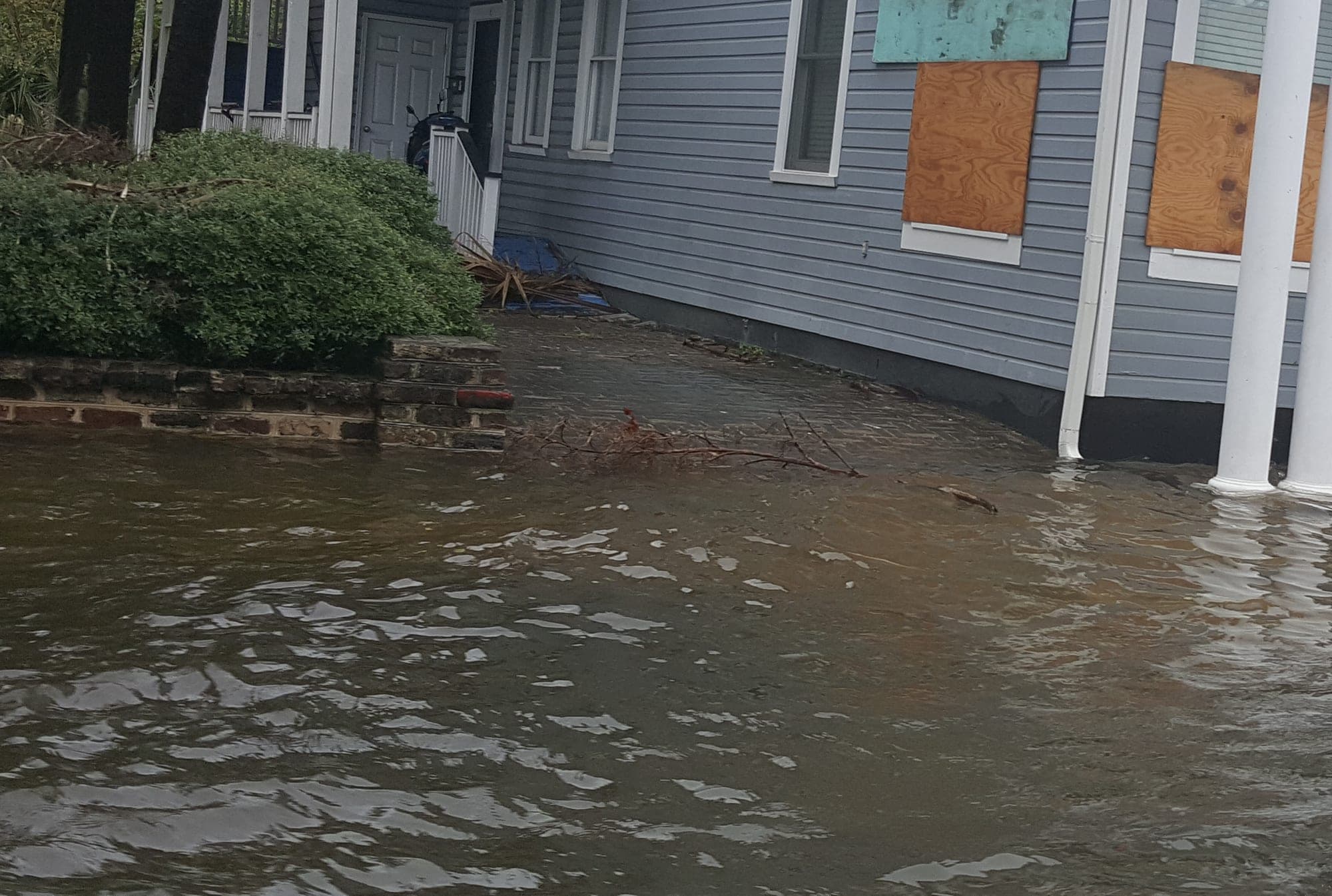
When heavy rain tied to Hurricane Isaias hit downtown Charleston on the morning of Oct. 10, flash flooding closed several roads and the harbor tide peaked at 7.76 feet, The Post and Courier reported, citing the National Weather Service. At the City Market, vendor Eric Floyd waded through standing water to stock his stall.
“You know, it’s always a consideration,” he told the newspaper, but “we live in a coastal town.”
Fewer properties in Charleston County carry federal flood insurance than did five years ago, and those that do are paying more.
In the federal fiscal year that ended Sept. 30, 2025, 50,153 National Flood Insurance Program policies took effect in Charleston County, not counting policies later canceled. That was down from 56,680 four years earlier, a drop of about 11.5%, according to a Charleston Business Report analysis of FEMA’s public policy records. Counted by insured units, which is how FEMA tallies condominium association policies that cover many units, the drop was about 5%. Over the same period, the median yearly cost of a policy, including federal fees and surcharges, rose from $577 to $977.
The decline has continued. Policies taking effect from October 2025 through August 2026 ran about 3% behind the same months a year earlier.
Why bills went up
The increases follow Risk Rating 2.0, FEMA’s pricing system, which applied to new policies starting Oct. 1, 2021, and to renewals starting April 1, 2022, according to the agency.
Federal law slows the change. “Existing statutory limits on rate increases require that most rates not increase more than 18% per year,” FEMA says.
That means many bills have further to climb. Of the county’s policies that took effect from October 2025 through August 2026, about 43% were priced below FEMA’s full-risk premium, the price the agency says reflects a property’s flood risk and the full cost of expected losses and expenses. For those policies, the full-risk premium was a median 1.7 times the premium charged, a gap of about $600 a year.
Across all policies that took effect in that period, premiums totaled about $48 million, while the full-risk premiums FEMA calculated came to about $70 million, before fees.
Where policies are dropping
Most of the decline came in lower-risk areas. Policies in X zones, where mortgage lenders typically don’t require flood insurance, fell about 23% between fiscal 2021 and fiscal 2025, compared with about 7% in the high-risk A zones, the analysis found.
Lower-risk areas still flood. The city of Charleston says on its website that about 25% of all flood insurance claims come from low-to-moderate risk areas, The Post and Courier has reported.
What businesses pay
In fiscal 2025, 2,056 federal flood policies on nonresidential buildings took effect in Charleston County, covering about $1 billion in buildings and contents. Their median cost was about $2,200 a year, little changed from 2021. About 510 of those policies were flagged as covering small businesses, defined as those with fewer than 100 employees.
For business owners, more increases may be coming but are less widespread. About a quarter of nonresidential policies that took effect from October 2025 through August 2026 were priced below full risk, with a median gap of about $920 a year.
The federal program covers up to $500,000 for a business building and $500,000 for contents, The Post and Courier has reported. Standard commercial property policies don’t cover flood damage, and flood policies don’t cover lost business income, the S.C. Department of Insurance says on its website.
That income can disappear without a direct hit. Charleston-area hotel occupancy can fall 10% to 40% when a storm threatens, Daniel Guttentag, director of the College of Charleston’s Office of Tourism Analysis, told The Post and Courier in an article published Oct. 22.
What flooding has cost
Since the start of 2015, federal flood claims in Charleston County have totaled about $116 million, according to FEMA claims records. Most of it came from three events: the October 2015 floods, about $25 million on 1,928 claims; Hurricane Matthew in 2016, about $34 million on 1,417 claims; and Hurricane Irma in 2017, about $39 million on 1,495 claims.
Losses since have been smaller. Claims from 2018 through this summer total about $15 million, including about $2 million from Tropical Storm Debby in August 2024. In fiscal 2025 alone, county policyholders paid about $66 million for their policies. FEMA pools premiums nationally and prices for losses over time.
How communities are cutting costs
Local governments can lower premiums by joining FEMA’s Community Rating System and taking steps such as stricter building rules and buying out flood-prone land. Unincorporated Charleston County has the region’s best rating, Class 2, worth a 40% discount for policies in high-risk zones, according to FEMA’s community status records.
Mount Pleasant moved up to Class 5 in April, raising its discount in high-risk zones to 25%. North Charleston and the town of James Island reached Class 5 last October. The city of Charleston is Class 6, with a 20% discount.
“Insurance is going to be higher here no matter what we do, but if the city can help in some way of bringing it down, that’s what we’re going to do,” North Charleston floodplain manager Toyah Smith told The Post and Courier in 2025.
A December deadline
Congress must periodically renew the program itself. Its authority now runs through Dec. 11, according to a FEMA page updated Sept. 28. If it lapses, FEMA says it could still pay valid claims but would stop selling and renewing policies.
How we reported this
We analyzed FEMA’s OpenFEMA NFIP Redacted Policies data for Charleston County, identified by the census geography in each record, for federal fiscal years 2021 through 2026. We counted policy records by the date they took effect and left out records marked as canceled. That measures policies written or renewed during each year, not FEMA’s official count of policies in force, and it counts a condominium association policy once even when it covers many units. The fiscal 2026 figures cover policies effective through August 2026 because of reporting lag. We also used NFIP claims records since 2015, FEMA’s Community Status Book and its October 2026 Community Rating System list, FEMA’s Risk Rating 2.0 and reauthorization pages, the S.C. Department of Insurance’s guidance for businesses and Post and Courier reporting.