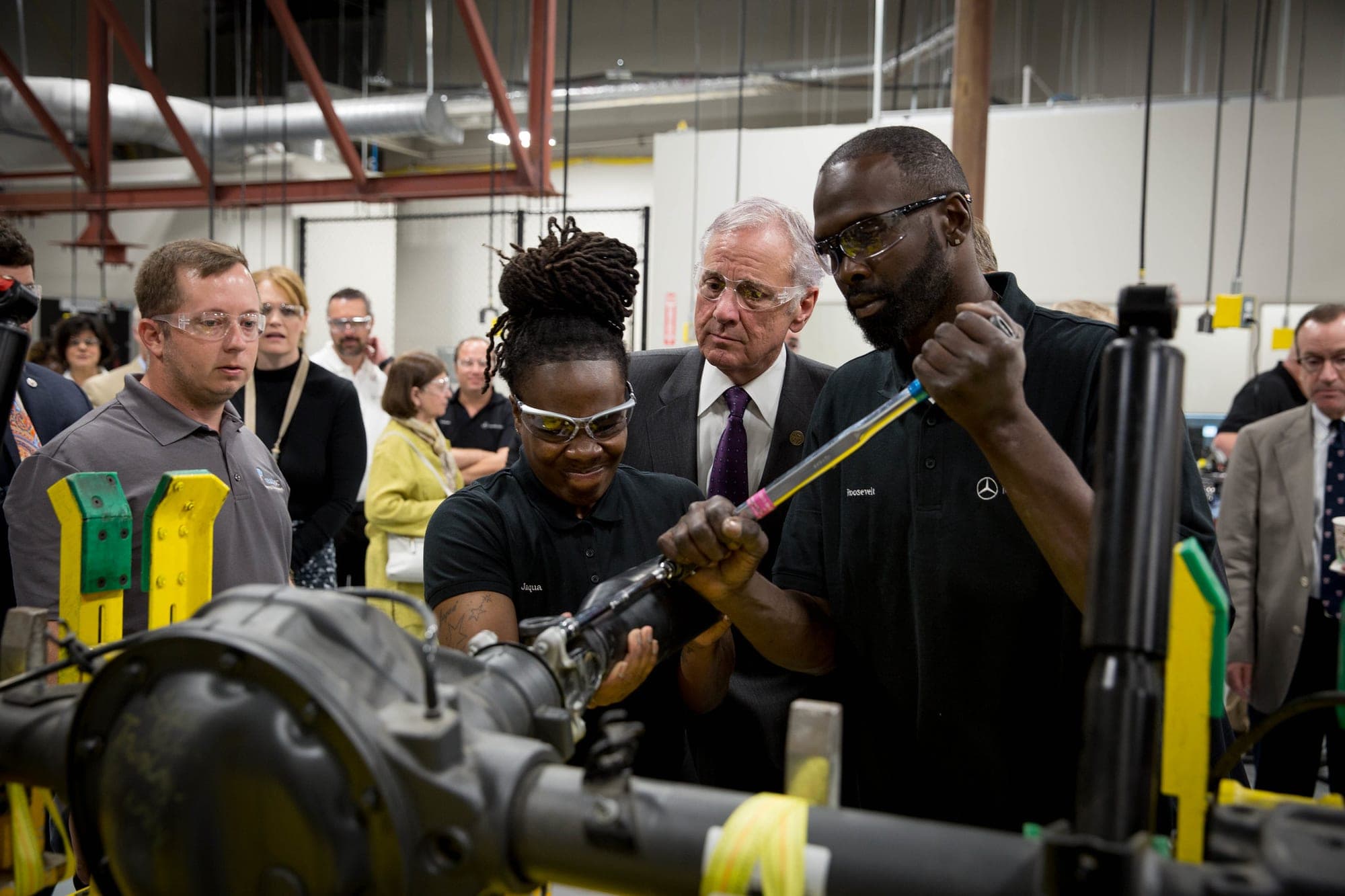
The Charleston region’s fastest-growing kind of work over the next five years is expected to be on the factory floor.
Production jobs are projected to grow 16.7% from 2025 to 2030, adding about 3,945 positions, according to the Charleston Metro Region Talent Demand Study 2026. The Charleston Metro Chamber of Commerce and the Charleston Regional Development Alliance released the study Sept. 15. No other occupation group in Berkeley, Charleston and Dorchester counties is projected to grow faster or add more jobs.
Information technology led the previous forecast. The study attributes the change to “continued manufacturing investment as well as the resurgence of maritime manufacturing in the region.”
Across the three counties, the study projects about 33,200 net new jobs by 2030, a five-year growth rate of 7.9%. The forecast is based on data from Chmura Economics’ JobsEQ, adjusted for known major business expansions and announcements. Economists held mixed views on the outlook when the study was published, it says, though most did not expect a major recession in the next several years.
Where the growth is
After production, the fastest-growing groups are architecture and engineering, projected to rise 14.3%, and information technology, at 12.6%. Installation, maintenance and repair, and construction and extraction follow at 9.8% and 9.7%.
Ranked by number of new jobs, production is followed by transportation and logistics with 2,915, food preparation and serving with 2,883 and management with 2,651.
The manufacturing jobs in highest demand include team assemblers, production supervisors, inspectors and welders, along with industrial, mechanical, civil, electrical and aerospace engineers. The study notes that “not all require a four-year degree.”
Turnover will open even more doors than growth in some fields. The study projects 41,678 openings in food preparation and serving from 2025 to 2030 as workers retire, leave the labor force or switch occupations. Office and administrative support follows with 28,554 and sales with 27,437.
Where the gaps are
The study measures potential shortfalls three ways. Comparing employer demand with degrees the region’s colleges awarded in the 2023-24 academic year, it estimates annual shortages of 501 workers in education instruction and library jobs, 429 in architecture and engineering, 330 in management, 329 in information technology and 209 in business and financial operations.
Among jobs that typically don’t require a degree, the largest projected annual gaps are in installation, maintenance and repair, at 150, and construction and extraction, at 101. For credentials, the study estimates a potential annual shortage of 97 certified nursing assistants, along with 54 licensed practical nurses, 47 holders of the federal Transportation Worker Identification Credential, 46 forklift-certified workers and 30 CPAs.
Pay is up, but not everywhere
Average annual wages across all occupations reached $64,500 in 2025, up from $50,810 in 2020, the study says. After inflation, that is real growth of 2.5% over five years.
Production is an exception. The average production wage was $53,600 in 2025, and real pay fell 7.2% from 2020 to 2025, according to the study. “Production is one of the few occupation categories where real wages have declined even as employment has increased,” it says.
Real wages also fell over the five years in management, by 17.4%, and in legal occupations, by 9%, along with construction, installation and repair, office support, and farming, fishing and forestry, the study’s figures show.
The alliance’s year
A day after the study came out, the development alliance released its 2025-26 annual report. During the fiscal year, seven announced projects accounted for 249 direct new jobs at an average hourly wage of $30.06, $15.57 million in new payroll and more than $265 million in annual economic impact, the alliance said.
Its business development team made 17 recruiting missions, with core travel areas including Germany, the United Kingdom, Italy, Spain, Switzerland, Taiwan, Dubai and Turkey, and generated more than 130 leads, according to the report. Its free job board, CharlestonCareers.org, sent 5,857 qualified applicants to employers.
The Charleston Workforce Housing Fund, an effort driven by the alliance’s Economic Leadership Council to preserve apartments near employers, raised $40 million in its first year. It bought West Wind Apartments in Charleston County and Waverly Place in Dorchester County, 500 units in all, with 20-year deed restrictions, the report says. It lists rents at 20% below market and a goal of 1,000 units.
The alliance reported $4.34 million in revenue for the fiscal year, 51% from the private sector and 29% from the public sector. In the year ahead, the report says, it will put more focus on corporate headquarters relocations and defense companies.
It is also adding to its business development staff. John O’Toole, the founding executive director of the Beaufort County Economic Development Corp., joins the alliance Nov. 2 as vice president of economic development, the alliance announced Oct. 6. Under his leadership, the Beaufort County agency completed more than 100 projects representing about $1 billion in capital investment and more than 3,400 jobs, the alliance said.
“His experience, relationships and understanding of South Carolina’s economic development landscape will be a strong asset to CRDA and the region,” said David Ginn, the alliance’s president and CEO.