Lynette Youson was 5 when she began sewing scraps of grass beside her great-grandmother, according to the Smithsonian American Art Museum.
More than 50 years later, she sells her baskets under the name Sweetgrass Creations, teaches the craft to children and adults, and helps make sure other weavers can find the grass their businesses depend on.
Youson calls herself a fifth-generation sweetgrass basket weaver on her business website, and the U.S. Army Corps of Engineers and the Town of Mount Pleasant describe her the same way. She has woven alongside her mother, Marilyn, for decades, and her daughters, LaNeikqua and Kimberly, and her granddaughters weave too, the Corps reported in 2022.
The craft goes back centuries. The Gullah community, which traces its lineage to enslaved West Africans on the South Carolina coast, brought basket weaving from Africa and has passed it down since the 1700s, according to a July story by the Corps’ Charleston District. Baskets once used in the rice fields have become an art form found everywhere from the markets of Charleston to roadside stands on U.S. Highway 17, the Corps said.
Among her best-known pieces is the Gullah rice fanner, the Corps reported, a wide, flat basket the Smithsonian says was used to separate rice grains from their husks. The museum holds her 2002 Gullah Fanner Basket, about 2 feet across and made of sweetgrass, bulrush, pine needles and palmetto fronds. The State Department’s Art in Embassies program lists two of her baskets, an oval rice fanner and a lidded sewing basket, in connection with a 2011 exhibition in Dakar, Senegal.
Her work has also been displayed during President Barack Obama’s inauguration parade, where a cross she designed was carried, the Corps reported. Her website says she has been featured on CBS Sunday Morning.
The work is slow. Youson told CBS News in 2015 that she pulls green sweetgrass by hand and spreads it in the sun for three to five days to dry. She estimated a basket like the one she was making then would take roughly 10 hours and sell for about $350 to $375 at the time.
She compared the technique to crocheting. “You tie a knot and then you work around that knot,” she told CBS.
Her business website shows a gallery of baskets and takes inquiries through an online form. She also weaves at the Sweetgrass Pavilion at Memorial Waterfront Park in Mount Pleasant, where she teaches residents and visitors about the art form’s history, the town said in 2024. That October, the town announced a football-shaped sweetgrass trophy she made for the annual Sweetgrass Bowl football game between Wando High School and Lucy Beckham High School. It took about two months to make, according to the town.
Youson is a past chair of the Sweetgrass Cultural Arts Festival, held each summer at the pavilion, and works as an after-school instructor, according to the Corps and her website. She has taught hundreds of people, from kindergartners to 70-year-olds, the Corps reported in 2022. In that story, she said she worried that screens keep young people from practicing long enough to master the technique, but was encouraged when young people reached out to learn.
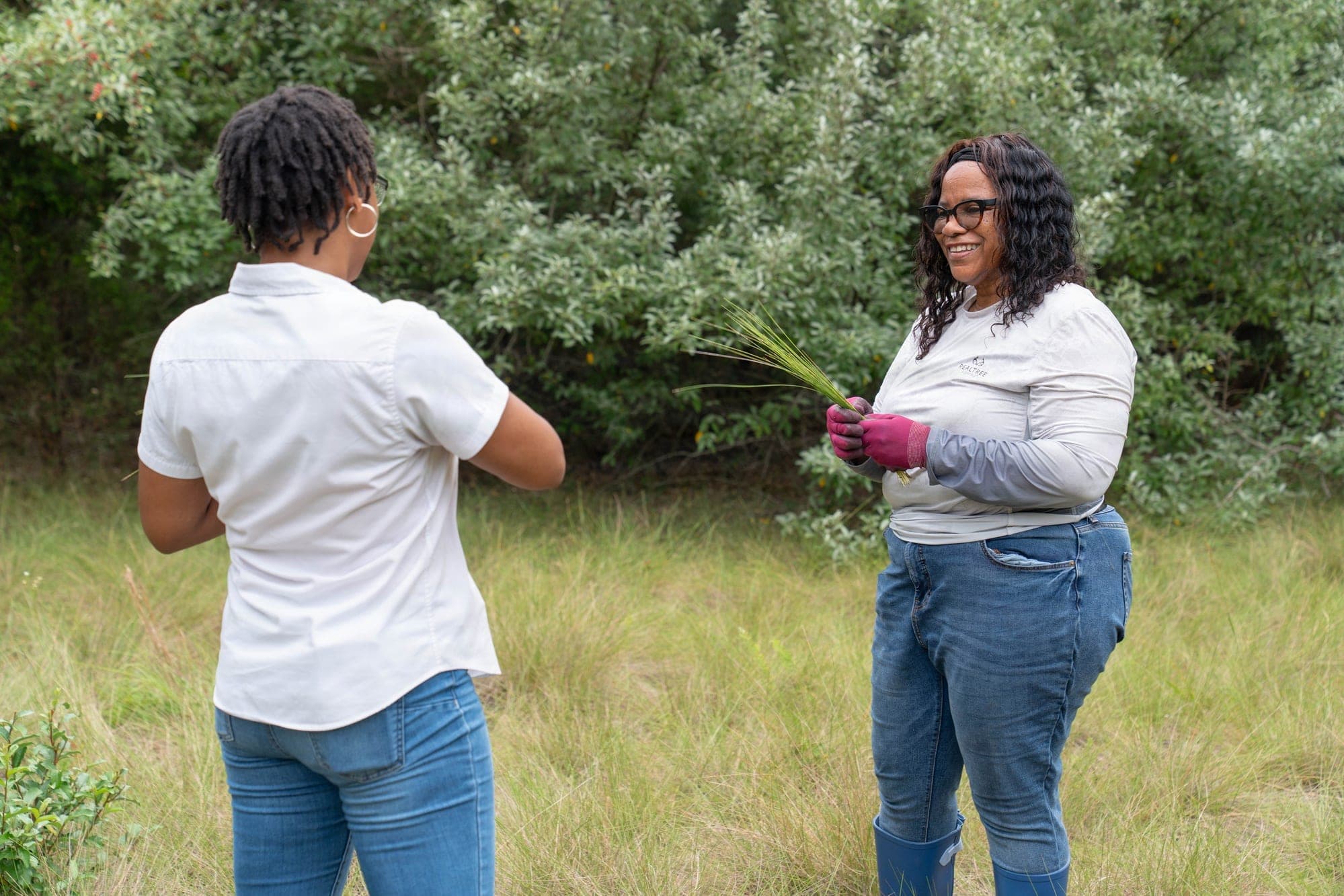
The raw material is the hard part. Coastal development has made sweetgrass harder to find, the Corps reported in 2022. For more than a decade, Youson has advised the Corps on the sweetgrass growing on the grounds of the Cooper River Rediversion Project in St. Stephen, which the Corps operates in partnership with Santee Cooper. The relationship led to free harvest days, known as pulls, for weavers.
“The grass at the CRRP is very fine, which is great for the intricate details the weavers often use on their baskets,” she told the Corps in 2022.
The relationship began with her friendship with Glenn Jeffries, the Charleston District’s former corporate communications chief, and has lasted 12 years, the Corps said in July. Youson leads groups of weavers, including relatives, to harvest at peak season. At the pulls, she encourages her grandchildren to take part and shows first-time pullers the proper technique, the Corps reported.
“I love to share, that’s why I bring some of the basket weavers here,” Youson told the Corps. “We can’t live in this world alone; some people want to hog everything up for themselves, but you won’t be successful doing things like that.”
Ronnie June, the project’s natural resources manager, said the district is “proud to be able to provide this natural resource to artisans of the Lowcountry to carry on traditions passed down from generation to generation.”
For Youson, the work has never been only about the baskets.
“‘Cause when I’m weavin’, it seems like I’m in my own world. I don’t have a thing to worry about,” she told CBS News.