Naval Information Warfare Center Atlantic spends heavily with private companies, and it tells them ahead of time what work it expects to put out for bid.
The September 2026 edition of the command’s industry forecast, posted on its website, lists 16 requirements it expects to open for proposals between October 2026 and May 2027.
Two carry estimates of $250 million or more. One is a 10-year corporate production supply contract now held by Science Applications International Corp., with a request for proposals expected in January. The other is a second round of cybersecurity assessment and authorization support, now held by KBR Wyle Services, with proposals expected to be sought in March.
Four more are estimated at $100 million to $250 million each, according to the forecast. They cover engineering and logistics support for Marine Corps communications systems, defense health infrastructure and application engineering, expeditionary engineering and life cycle support, and production and technical support for fielded ground systems.
The estimates are given as rough ranges. Five of the 16 jobs are set aside for small businesses, including the defense health work, now held by Spinvi Consulting. Most will be competed under the Navy’s SeaPort-NxG services contract vehicle, the forecast shows.
A big local customer
NIWC Atlantic engineers, buys, tests, installs and maintains communications, networking, cyber and surveillance systems. Its work ranges from shipboard networks and submarine radio rooms to equipment for Marine Corps vehicles, according to the command. It has more than 4,100 federal civilian and military workers, and most of them are in Charleston, the command says.
Its purchasing is large. Division figures in an October 2024 briefing by the command’s Fleet C4I and Readiness Department add up to about $824 million that the department alone obligated through 1,411 purchase orders issued by NIWC Atlantic in fiscal 2024, a CHS Business Report tally shows. Its 10 largest industry partners that year included national firms such as Scientific Research Corp., Leidos, Science Applications International, Amentum and M.C. Dean.
That spending ripples outward. A May 2025 study by the University of South Carolina’s Moore School of Business estimated that NIWC Atlantic generated about $2.1 billion in economic output in South Carolina in fiscal 2024, supporting 9,912 jobs and $810 million in labor income. The estimate counts the command’s own spending plus added business at defense contractors and other local companies.
Where contractors hear the pitch
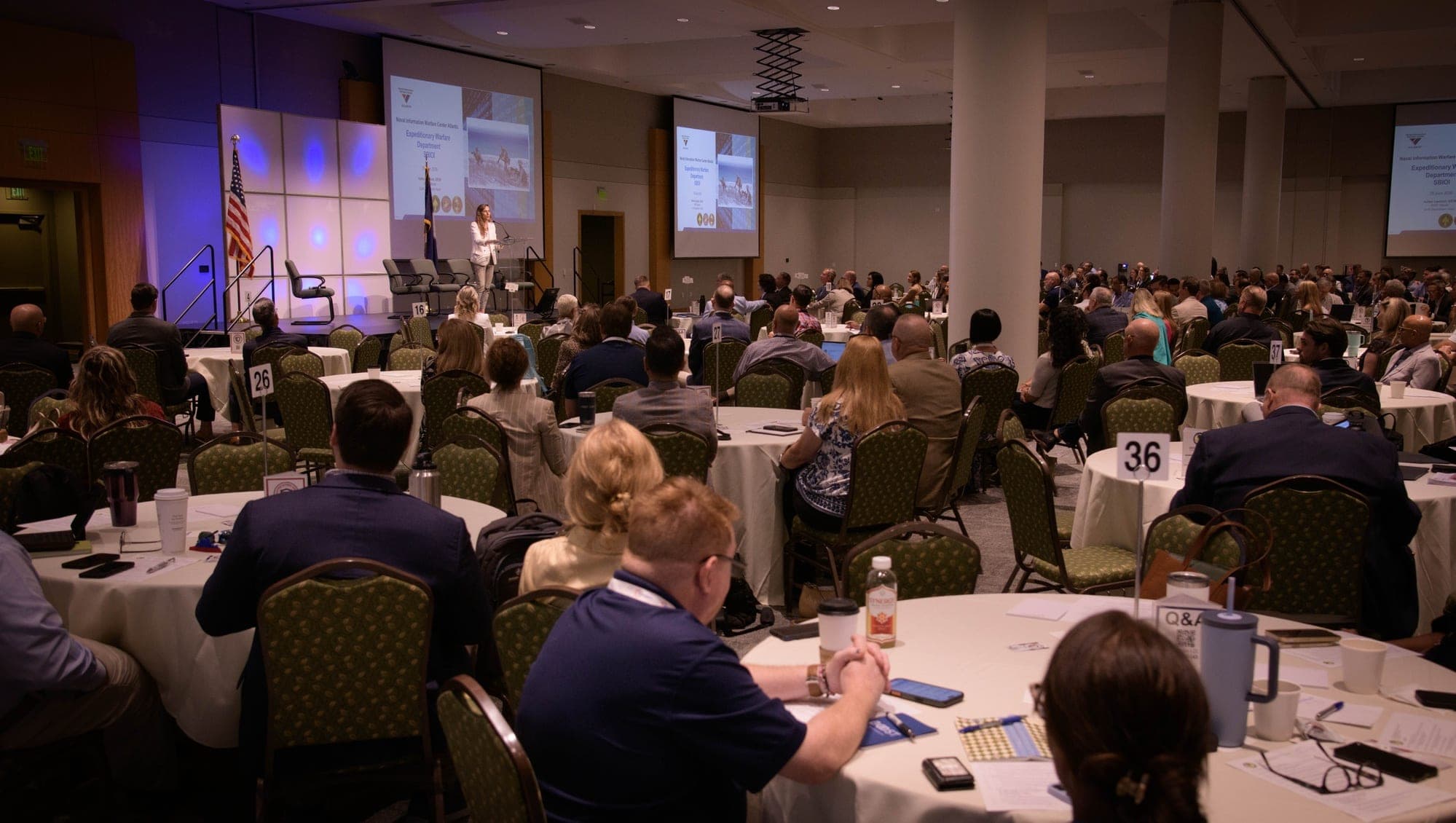
Much of the conversation between the command and industry happens at a symposium the Charleston Defense Contractors Association holds at Trident Technical College several times a year. Each one draws more than 500 people, the association says.
At the 74th session on June 25, Ashlee Landreth, head of NIWC Atlantic’s Expeditionary Warfare Department, spoke about her department’s role as the Navy reorganizes its buying offices into portfolio acquisition executives. Her slides told companies to understand the strategic intent behind acquisition reform, bid in terms of outcomes and solutions, and team with NIWC leadership.
The 75th session ran Oct. 14 and 15. The agenda listed Greg Lancaster, named the command’s executive director in September, for an introduction and command update, followed by a panel of NIWC Atlantic department heads. The second day’s agenda included NIWC contract updates, a briefing on quantum technology and industry opportunities, and a look at industry opportunities for 2027 from the Expeditionary Warfare Department. The association said the briefings would be posted on its website.
A faster lane for newcomers
The command has also opened a quicker route for commercial technology. NIWC Atlantic stood up a Rapid Capabilities Office on Oct. 23, 2025, and in January released its first contract opportunities under a commercial solutions opening, a competitive three-phase process meant to move market-ready products into prototypes quickly.
The first two requests sought a commercial solution that turns large amounts of raw data into usable information for unmanned maritime operations and a container-based hosting platform for applications. The opening runs through November 2028, and the command said it will keep publishing new requests over the next three years.
“These industry opportunities are the first of many more to come under the RCO CSO, which allows us to identify technology gaps and award commercial prototype solutions in months, not years,” said Jessie Rehwoldt, the office’s contracting officer, in the January announcement. She said the office welcomes existing industry partners and also new companies that may not be as experienced in working with the government.
The office’s mission spans five command focus areas: battlespace command and control, decision advantage, battlespace connectivity, robotics and autonomous systems, and non-kinetic effects, according to the command.
The next big gathering is the association’s Eastern Defense Summit, Dec. 8 to 10 at the Charleston Area Convention Center in North Charleston. The association says the summit draws more than 2,300 leaders from government, the military, academia and industry.