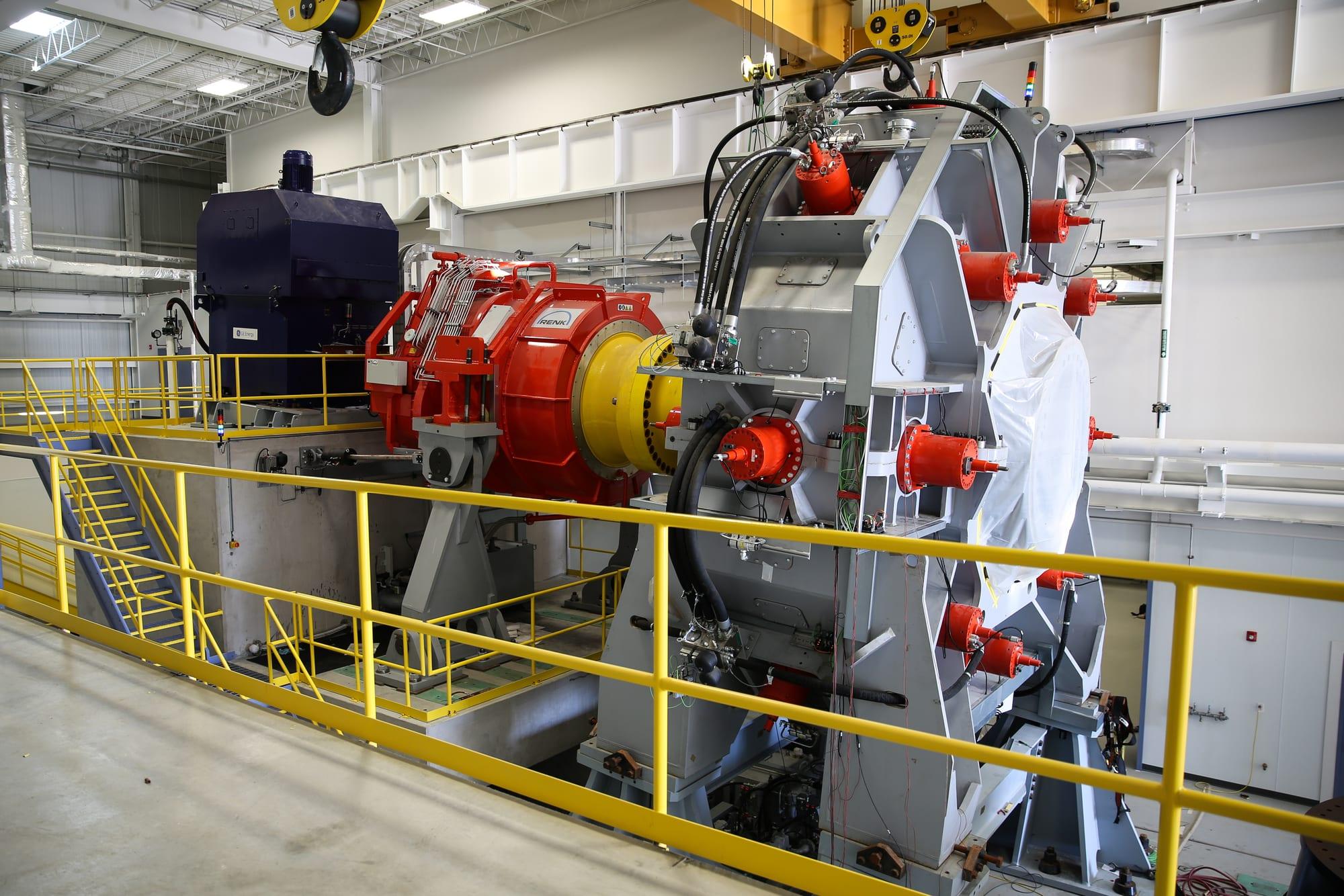
Clemson University dedicated its wind turbine drivetrain testing facility in North Charleston on Thursday and gave the building a new name: the SCE&G Energy Innovation Center.
South Carolina Electric & Gas Co. supported the center with a $3.5 million gift, the university said. The center sits on the Clemson University Restoration Institute’s campus at the former Navy base.
Clemson calls it the world’s most advanced facility for testing wind turbine drivetrains at full scale. A drivetrain takes the energy from a turbine’s spinning blades and speeds up the rotation to drive the generator, much like a car’s transmission, the university said.
More than 1,000 people attended, including elected officials, U.S. Department of Energy officials and industry executives from around the world, according to Clemson.
How it was paid for
The facility cost $98 million. The Energy Department paid $45 million through a grant, and $53 million came from public and private matching funds, Clemson said.
The department awarded the grant on Nov. 23, 2009. Clemson has called it the largest single award in the university’s history. The money came from the federal stimulus program, the American Recovery and Reinvestment Act.
Clemson said the site was picked partly for its location. It offers a working port facility on the East Coast and access by road, rail or ship for turbine makers worldwide, the university said.
The 82,000-square-foot building holds two test rigs. One can test drivetrains of up to 7.5 megawatts. The other can handle up to 15 megawatts and test units up to 13 meters across. Clemson said the larger rig weighs more than a Boeing 787 Dreamliner filled with fuel, passengers and luggage, and that many of its components had never been designed before.
The larger rig is expected to be running by summer 2014, Clemson said.
Duke Energy’s grid lab
The building also houses a 15-megawatt grid simulator. Duke Energy named it the Duke Energy eGRID, short for Electrical Grid Research Innovation and Development.
The simulator lets companies plug in electrical equipment and run it as if it were connected to a real power grid. Clemson said it can simulate the grid of any country in the world. The simulator project’s total value is $10.1 million, paid for in part by an Energy Department grant with matching money from the state and industry partners, the university said.
Duke Energy is contributing $5 million for lab infrastructure, educational programs and an endowed chair in smart grid technology. The state’s SmartState program matched that endowment to create two distinguished professorships, according to Clemson.
“This is an exciting day for South Carolina and Duke Energy, and our industry,” Duke Energy Chairman Jim Rogers said in Clemson’s announcement.
What they said
Clemson President James F. Barker said the two corporate names on the building should help the university recruit more industry partners.
“Clemson University is renowned for groundbreaking research, supercomputing, engineering and workforce development, but the Innovation Center and eGRID take the university to another level,” Barker said, according to the university.
Kevin Marsh, chairman and chief executive of SCE&G’s parent, SCANA Corp., said the utility was pleased to be a sponsor and partner.
“It is important for the private sector to work with public partners such as the U.S. Department of Energy and Clemson University to address the opportunities and challenges that face our industry,” Marsh said in the announcement.
U.S. Deputy Secretary of Energy Daniel Poneman said, “The Clemson testing facility represents a critical investment to ensure America leads in this fast-growing global industry,” according to Clemson.
GE signs up first
GE Power & Water announced at the dedication that it expects to be the first company to test at the center, Clemson said. It will use the 7.5-megawatt rig to test its next-generation wind turbine drivetrain for several months, starting in spring 2014.
Mark Johnson, general manager for renewables engineering at GE Power & Water in Greenville, made the announcement.
“Our collaboration with Clemson University will be an incredible asset to the development of more advanced GE drivetrain technology,” Johnson said, according to Clemson.
Two other partners will place engineers in the building, the university said. Savannah River National Laboratory will research grid security and resilience. FEV Inc., a German developer of powertrain and vehicle technology with North American headquarters in Detroit, will set up a research and development center at the campus.
New leaders
John Kelly, Clemson’s vice president for economic development, named Nikolaos Rigas executive director of the Restoration Institute. Rigas, who had been associate director, helped lead the grant application and the facility’s design.
Curtiss Fox, a former Clemson student who came up with the idea for the grid simulator, was named director of operations for the eGRID center.
“In this case, we had a Clemson student who worked with senior engineers and researchers and ended up developing a project that could change the world,” Kelly said, according to the university.
The center’s testing will reach beyond wind, Clemson said. Planned areas include energy storage, solar power, natural gas and diesel systems, smart grids and microgrids, fuel cells, aerospace systems, electric vehicle charging and grid security.
The day before the dedication, more than 100 engineers from around the world attended a technical workshop at the center sponsored by Shell Lubricants, the university said.