The Medical University of South Carolina’s hospital system took in more than $7 billion in operating revenue in the fiscal year that ended June 30, according to MUSC’s audited annual financial report.
The Medical University Hospital Authority, the arm of MUSC that runs MUSC Health’s hospitals and clinics, reported $7.01 billion in operating revenue and $6.61 billion in operating expenses. That left $401 million in operating income, a margin of about 5.7%.
The report is dated Oct. 2 and is posted on the website of the S.C. Office of the State Auditor. KPMG audited the statements and issued an unmodified opinion, according to the report.
A year earlier, the authority reported $5.38 billion in operating revenue and $138.1 million in operating income, according to MUSC’s fiscal 2025 report. By those figures, revenue rose about 30% and operating income nearly tripled.
The new report does not say what drove the jump. But unlike the 2025 report, its notes list bonds issued by Tidelands Health among the authority’s debts. Its transmittal letter describes a statewide system of 18 hospitals, five of them in development, with 2,823 licensed beds and more than 1,217 care locations.
Where the money comes from, and goes
Net clinical service revenue, the money the authority collects for patient care, was $6.64 billion. Salaries and benefits cost the authority $2.65 billion, and services and supplies cost $3.62 billion. Depreciation and amortization added $250.8 million.
MUSC Health also received about $47 million in state support for programs including disproportionate share payments, telemedicine, behavioral health and graduate medical education at Lancaster Medical Center, the report said.
MUSC “remains steadfast in its mission to deliver the highest quality patient care, even amid ongoing healthcare reform and reductions in Medicaid reimbursements,” the university’s finance officers wrote in the transmittal letter.
At an Aug. 13 committee meeting of MUSC’s trustees, MUSC Health CEO Dr. Patrick Cawley reported that the system exceeded its fiscal 2026 goals for operating margin, physician recruitment and oncology clinical trial enrollment, according to the board’s minutes.
The university and its doctors
The university itself, combined with University Medical Associates, MUSC’s nonprofit multispecialty group practice, reported $1.45 billion in operating revenue and a $233.8 million operating loss. Noncapital support, mostly state appropriations, totaled $253.2 million and more than covered the gap. The combined net position rose $73.7 million.
University Medical Associates’ operating revenue rose 6.5% to $751.1 million. Its expenses rose 10.2% to $690.4 million, driven largely by a $55.1 million increase in faculty salaries tied to growth in its physician and clinical workforce, according to the report. Its net position fell $11.4 million, including a $31.1 million loss tied to a change in its relationship with Carolina Family Care, a primary care network that converted from a for-profit company to a nonprofit corporation.
MUSC reported $411.7 million in research expenditures for the year, about $366 million in outside research awards, about $122 million in philanthropic commitments and a record 193 invention disclosures from faculty and staff.
The university employs about 6,500 faculty and staff. With the hospital authority and the physician practice, the MUSC system employs more than 37,000 people, the report says.
Building, and borrowing, close to home
Several of the largest projects in the report are in the Charleston region.
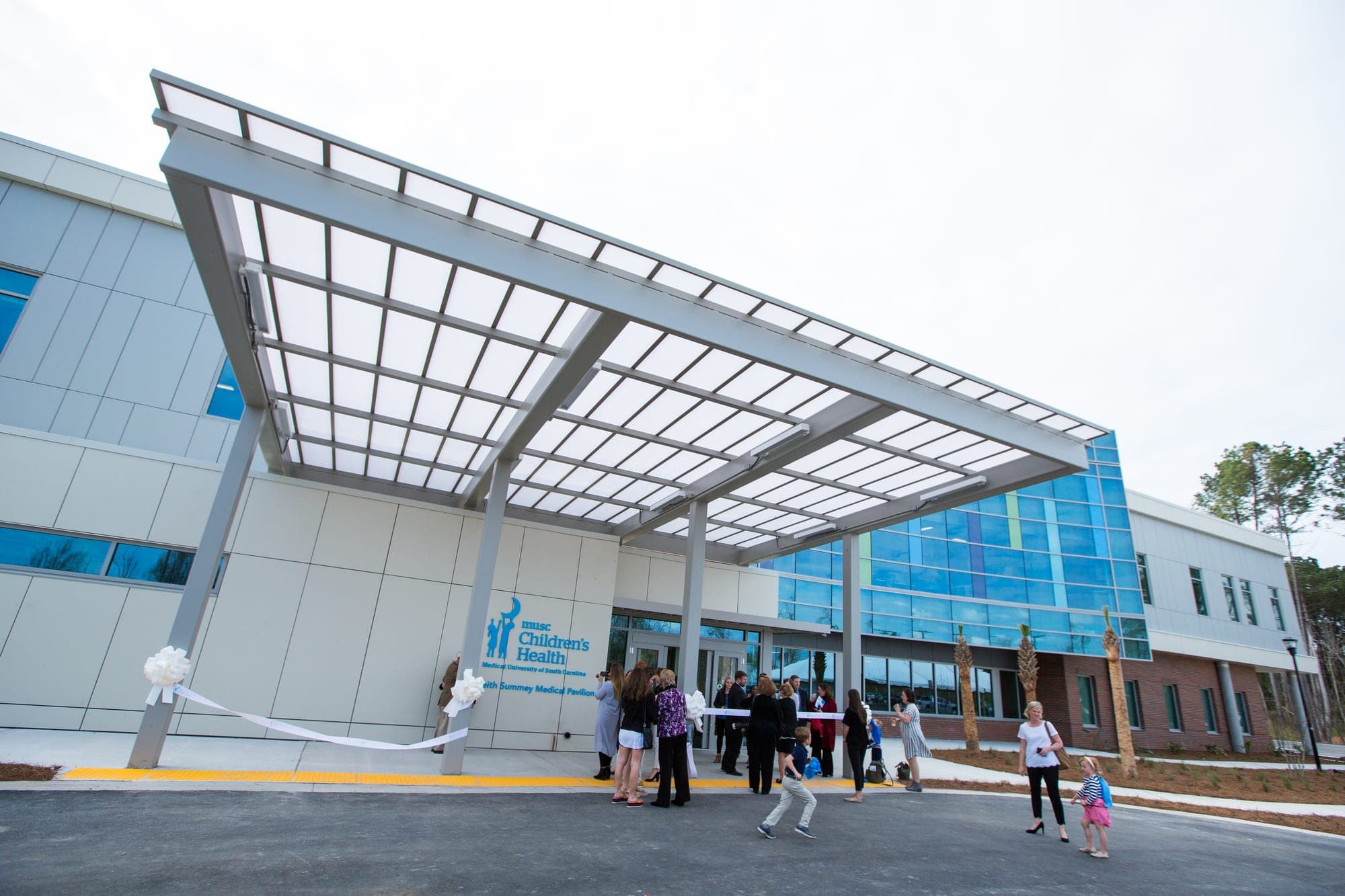
University Medical Associates spent $45.2 million during the year on its Clements Ferry Medical Pavilion building and $13.6 million on equipment for it. The 80,000-square-foot medical office building on Clements Ferry Road was financed with $75 million in bonds issued for the practice in February 2025 through the S.C. Jobs-Economic Development Authority, money that also covers an expansion of the West Ashley Medical Pavilion.
In Nexton, the practice borrowed $11.2 million on its line of credit to buy land for future development, and on July 1 it issued $95 million in tax-exempt bonds, placed with Wells Fargo, to build medical office facilities there. The report gives a tentative July 2027 opening for the Nexton Medical Pavilion, possibly in phases.
That is separate from the $311.5 million in federally insured bonds the hospital authority issued June 25 to build its Nexton hospital. MUSC said Oct. 22 that the 70-bed hospital is expected to open in summer 2028.
Downtown, the university had $129.1 million in construction in progress at June 30, mostly for the new College of Medicine building, which the report says should open early in fiscal 2028. The state has authorized $175 million for MUSC’s planned cancer hospital, money that will pass through to the hospital authority. MUSC plans to seek another $175 million in the next state budget cycle, Mark Sweatman, MUSC’s vice president for external affairs, told a trustees committee in August, according to the minutes.
Outside the region, the authority borrowed $254.4 million in December 2025 to build a hospital at Indian Land in Lancaster County.
“Guided by our mission to preserve and optimize human life, MUSC continued to grow with discipline, invest strategically and advance excellence in education, research and patient care,” Dr. David Cole, MUSC’s president, wrote in a letter opening the report.
Cole plans to retire in June 2027. MUSC’s trustees are searching for his successor.