A development team behind some of the best-known building reuse projects in New York, Atlanta and Charleston is taking on the north end of the former Charleston Naval Base.
The project, called Navy Yard Charleston, calls for more than 1.2 million square feet of new offices, homes, shops and restaurants, The Post and Courier reported Sunday. The plan had not been previously reported, the newspaper said.
The team includes Atlanta-based real estate firm Jamestown, Atlanta developer Weaver Capital Partners and WECCO Development of Charleston.
“I think the idea is to create an exciting, aspirational place for people to work and live and be entertained,” said Michael Phillips, Jamestown’s president.
Detailed planning is in the early stages, but some work is expected to start this year, according to the newspaper. The full project is expected to take 10 to 15 years.
A concert hall in the Power House
The plan mixes buildings already occupied by businesses, new construction and the renovation of vacant historic buildings, The Post and Courier reported.
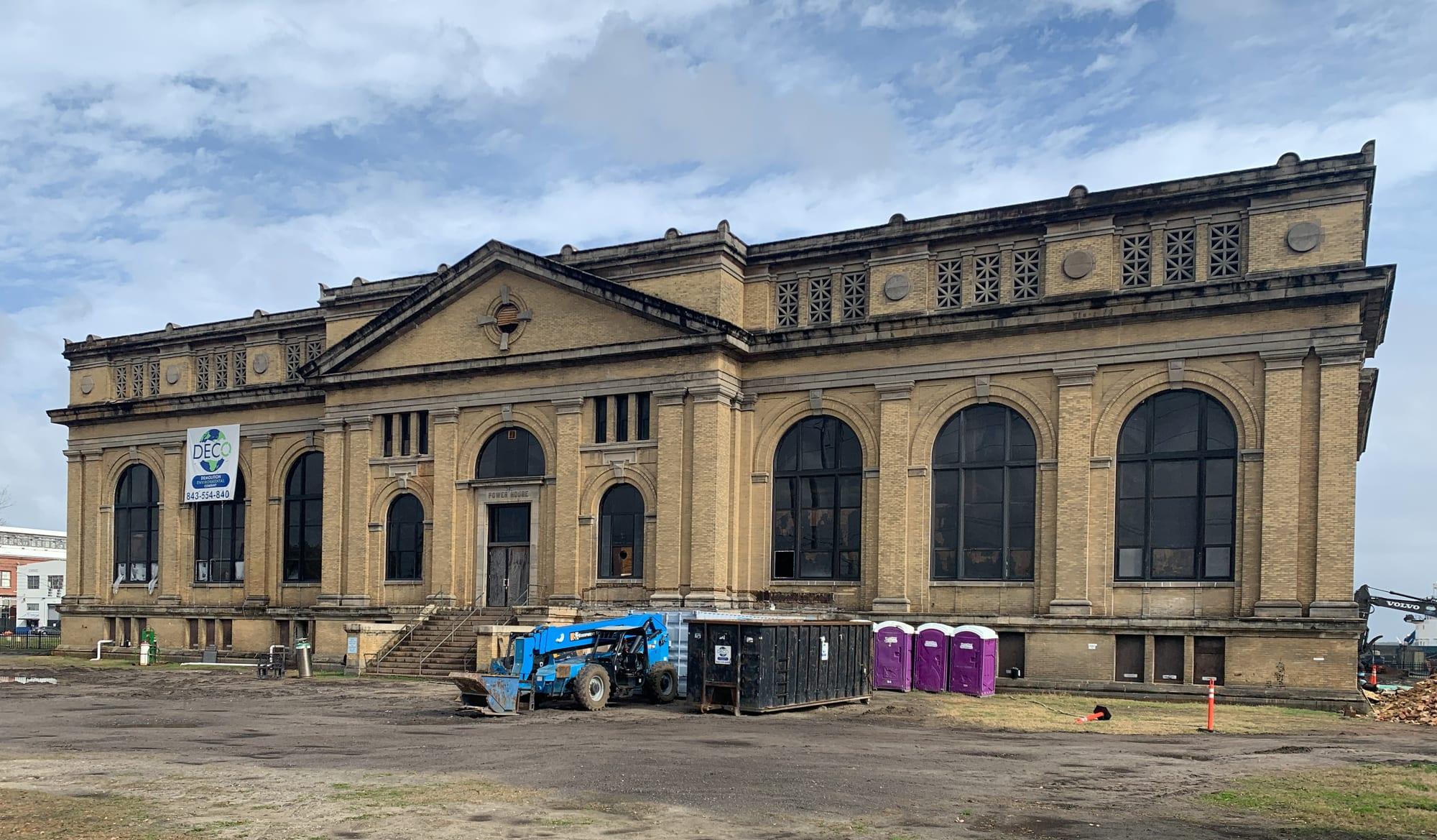
One of the buildings in the plan is the Power House, a historic and environmentally challenged building that once supplied power to the base. It was built in 1909, according to the newspaper, and the developers say it could become a national music venue.
“We are talking to a national music venue about going there,” said Jay Weaver of Weaver Capital Partners.
Weaver and William Cogswell of WECCO have spent several years assembling property on the former base, including Storehouses 7, 8, 9, 10 and 11, the Power House and a large parking lot, The Post and Courier reported. Jamestown joined when a deal was pending with Palmetto Railways, the state railroad agency, that will substantially add to those holdings.
The result will be a roughly 45-acre swath north of McMillan Avenue, west of Noisette Boulevard and east of the Palmetto Railways freight line, the newspaper reported.
The team
Jamestown is headquartered in Atlanta and Cologne, Germany, and was managing more than $12 billion in assets at the end of 2020, according to The Post and Courier. Its U.S. projects include Chelsea Market and Industry City in New York, Ponce City Market in Atlanta and Ghirardelli Square in San Francisco.
Weaver Capital Partners’ projects include the Cigar Factory in Charleston, Puritan Mill and Westside Provisions District in Atlanta, the latter developed with Jamestown, and Edgehill Village in Nashville.
Cogswell is a member of the S.C. House who represents Charleston and Mount Pleasant. He specializes in renovating historic buildings, and his Charleston-area projects include the Cigar Factory with Weaver, GARCO Mill and One Cool Blow.
Tim Keane, Atlanta’s planning commissioner and the city of Charleston’s top planning official until 2015, said the developers’ Atlanta projects were “wonderfully done.”
“I would say they are a group that really likes challenging sites and thrives on difficult situations,” Keane told the newspaper.
The hospital next door
Last year, a team led by Cogswell and Weaver bought the vacant former Charleston Naval Hospital, the tallest building in North Charleston, from Charleston County, with plans to turn it into apartments. The 10-story building sits on 23 acres at Rivers and McMillan avenues, across Spruill Avenue from the former base.
“The reason we got into the Navy hospital is we saw it as a front door to properties we already owned,” Cogswell said in a January interview with The Post and Courier.
Tax breaks are part of the math. The area is a federal Opportunity Zone, which offers investors large reductions in capital gains taxes in lower-income areas.
“The entire Navy Yard is an Opportunity Zone, and we’ll be doing historic tax credits on numerous buildings,” Weaver said.
A second try
The base, which closed in 1996, has seen ambitious plans before. The Noisette plan for the same area was announced 20 years ago and, after some success, ended in foreclosure, The Post and Courier reported.
This time, the developers point to growth. North Charleston is increasingly central as the region spreads out, and soaring home prices in Charleston and Mount Pleasant have added to interest in the city, the newspaper reported.
“You can already see it in the migration, and we think that’s going to continue to happen,” Weaver said.
The development team plans a neighborhood employment program that would reserve some jobs for local residents and train job seekers, according to the newspaper.
Omar Muhammad, president of the Lowcountry Alliance for Model Communities, a coalition of neighborhoods in North Charleston’s south end, said he hopes the developers “can be intentional about how it can improve the quality of life for people who live nearby.”
North Charleston Mayor Keith Summey said the city has not seen detailed plans, but he expects the project to complement the city’s own efforts at the northeast end of the former base, according to the newspaper.
“It’s part of the industrial landscape,” Phillips said of the base’s working waterfront, port and rail lines. “I would argue that people want real places.”